

I’ve worked in digital marketing since 2002, and I didn’t plan to become an SEO specialist. I got there because of a bad experience.
Years ago, the business I worked for hired an SEO agency. Every month we got stories, and links from websites that had nothing to do with us. I couldn’t tell whether any of it was working, and nobody could explain it to me in plain terms. So I did a short SEO course to understand what we were paying for. I was hooked, and went on to get properly certified.
Since then I’ve watched search change underneath businesses more than once. Google’s Panda update in 2011 and Penguin in 2012 wiped out the visibility of companies that had relied on thin content and bought links. Hummingbird in 2013 taught Google to understand what people meant, not just the words they typed. Each time, the businesses that had taken shortcuts got hurt, and the ones that had built something real came through.
The shift happening now is bigger than any of those. Search is moving from a list of links to an answer, written by AI. Here is what that looks like from inside our clients’ data, and what South African businesses can do about it.
From ten blue links to one AI answer
When ChatGPT launched at the end of 2022, most people treated it as a novelty. Very few saw it as the next search engine. Then Google answered with Gemini, AI Overviews and AI Mode, and a wave of other AI tools followed. Search hasn’t been the same since.
People have woven AI into their daily lives far faster than anyone expected. I recently met a woman who has named her ChatGPT “Cathy”. Cathy talks to her, and she asks Cathy everything, including which business to call.
That changes how your customers find you. Before, someone typed a question into Google, scanned a list of websites and clicked a few. Now Google or ChatGPT often writes the answer for them, right there. Many people read it and never click through to anyone’s website.
About eight months ago, I started seeing this in our clients’ Google Analytics. Across several clients, clicks from Google dropped by roughly 10–20%, and leads followed. What made it stand out was that their rankings hadn’t moved. They were still on Google’s first page. People simply weren’t clicking.
What AI did to content
There’s a second side to this. When AI writing tools arrived, many businesses decided they no longer needed copywriters. Within months the internet filled up with articles that all said much the same thing.
Google caught on. It doesn’t penalise content just because AI helped write it. It pushes down content that adds nothing new, and a great deal of AI-written content fell into that trap. The irony is that AI tools look for the same thing Google does: original, specific, trustworthy information they can quote.
What one industrial client's data shows
One of our clients is an industrial compressed-air supplier serving mines, factories and construction sites across South Africa. Its numbers from February to September 2026 show both sides of the shift.
The site is being seen less. It appeared in Google results 9,587 times in March and 6,774 times in September, a drop of 29%. The number of keywords ranking in Google’s top three fell from 45 to 26 over the same period.
But more people clicked, and most of the growth came from people who already knew the name. Monthly clicks from Google rose from 66 to 92. Clicks from searches for the company’s own name went from 7 to 23. August was the one dip, with brand clicks down to 11 and total clicks to 80, before both recovered in September.
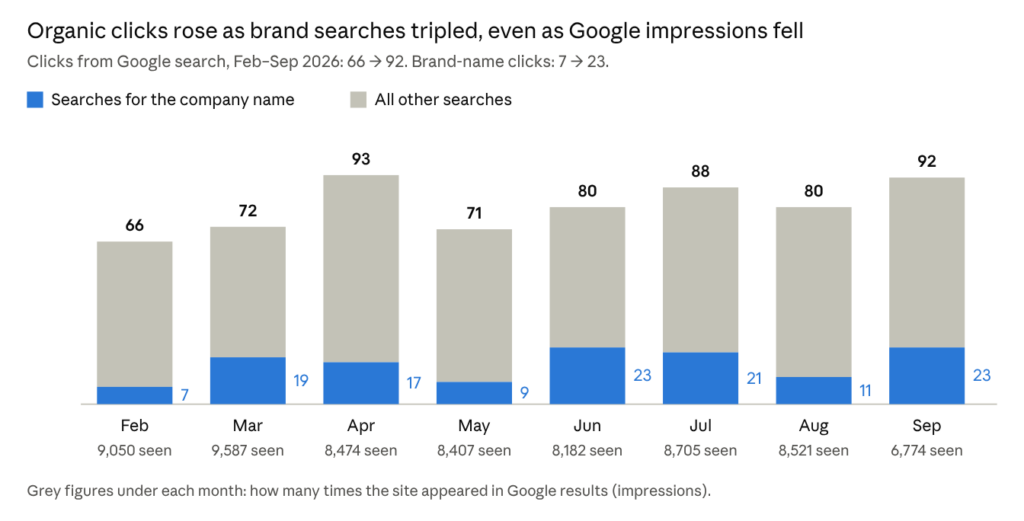
Google Search Console, monthly client reports, February–September 2026
The lesson for B2B and industrial businesses is that general questions are increasingly being answered by Google and AI tools. “What size compressor do I need for a mine?” gets an answer without a click. The searches that still lead to a website, a call or a form are the ones where the buyer already knows who they want.
That’s why we don’t treat SEO on its own. For this client, LinkedIn, Facebook and Google Ads build the brand that people later search for. In September, Google Ads alone brought in 32 enquiries, 13 contact forms and 11 phone calls among them.
AI traffic is still small for this kind of business. Google Analytics recorded 3 visitors from AI assistants out of about 1,800 in September. That’s no reason to relax. It means AI is answering the questions before buyers reach a website, and deciding which suppliers to mention while it does. Across our client base, Claude and ChatGPT are the AI tools sending the most visitors. Clients selling upmarket goods have barely felt the change, because their customers search for a brand they’ve already chosen.
Three things to fix first
When a business asks me where to start, my answer is always the same three things. None of them is new or flashy. They matter more now because AI tools rely on them to decide which businesses are real, relevant and worth recommending.
- Fix your Google Business Profile. It’s often the first thing Google’s AI reads about a local business. Make sure every field is complete and accurate: your services, the areas you serve, your hours, photos and contact details. An outdated or half-finished profile tells Google you might not be the safest recommendation.
- Get more reviews, and reply to them. People want to see real interactions with real customers, and so does AI. A steady stream of recent, detailed reviews is one of the clearest signals that your business is active and trusted. Make asking for a review part of how you finish every job.
- Make sure your website is built properly, with schema markup. Schema is code that tells search engines and AI exactly who you are, what you offer, where you are and what your customers ask. Very few web developers implement it, which means most businesses are leaving AI to guess. We add it to every site we build, along with a proper FAQ page that answers the questions your customers really ask.
Behind all three sits original content. AI tools quote businesses that say something specific: a real price range, a real process, a real result. If your website reads like everyone else’s, AI has no reason to mention you.
How to check whether AI mentions your business
You can run a simple version of the test we use with clients in about ten minutes.
- Write down five questions your customers ask before they buy. Use their words, not yours. For example: “Who services industrial air compressors in Gauteng?” or “What’s the best hair salon in Durbanville for curly hair?”
- Ask them in ChatGPT, Claude, Gemini and Google’s AI Mode. Note whether your business comes up, which competitors do, and what the AI says about each of them.
- Check Google Analytics for the AI Assistant channel. Google added it in May 2026. Go to Reports, then Acquisition, then Traffic acquisition, and look for the “AI Assistant” row. It shows visitors who arrived from tools like ChatGPT, Gemini and Claude.
Treat that Analytics number as a minimum. Visits from Google’s own AI Overviews still show up as ordinary organic search, and many people read an AI answer and then type your name into Google, or phone you, without clicking anything.
For clients, we go further with AI visibility software that tracks how often a business appears in AI answers for the questions that matter in its industry, and how that changes over time.
Adapt or die
Search is shifting to AI, and businesses need to be prepared. Some people treat AI search as a fad, and others throw money at it in a panic. Neither works. You need to adapt and keep learning, and spend wisely while you do.
The businesses that came through Panda and Penguin were the ones that had built something real. The same will be true this time. If AI is going to recommend someone to your customers, make sure it has every reason to recommend you.
Not sure whether AI tools can see your business? Book a free 30-minute strategy call and we’ll show you where you stand.
Frequently asked questions
AI search is when a tool like ChatGPT, Gemini or Google's AI Mode writes an answer to a question instead of only showing a list of websites. It draws on websites, business profiles and reviews to write that answer.
Yes. AI tools rely on the same foundations as Google: a well-built website, original content, an accurate Google Business Profile and real reviews. Good SEO is what gets you into the AI answer in the first place.
Not because AI wrote it. Google pushes down content that is unoriginal or unhelpful, whoever wrote it. Mass-produced AI content often falls into that category.
Ask it the questions your customers ask, and check the AI Assistant channel in Google Analytics. An agency can track this over time with AI visibility tools.
Complete your Google Business Profile, build a steady flow of reviews, and ensure your website includes schema markup and an FAQ page.